Voice AI has had the same problem for years: the silence. You ask something, the model thinks, you wait, and then the answer arrives. That two-second gap is small on paper, but it breaks the rhythm of a conversation every single time.
On September 15, 2026, Google announced two models aimed squarely at that gap. Gemini 3.8 Live and Gemini 3.8 Live Extended Thinking are what the company calls its "most advanced live dialogue models yet." They follow 3.1 Flash Live, which shipped back in March, and they're built around one goal: making a conversation with AI feel intuitive instead of transactional.
Two Models, Two Different Jobs
Instead of one flagship, Google shipped a pair that complement each other.
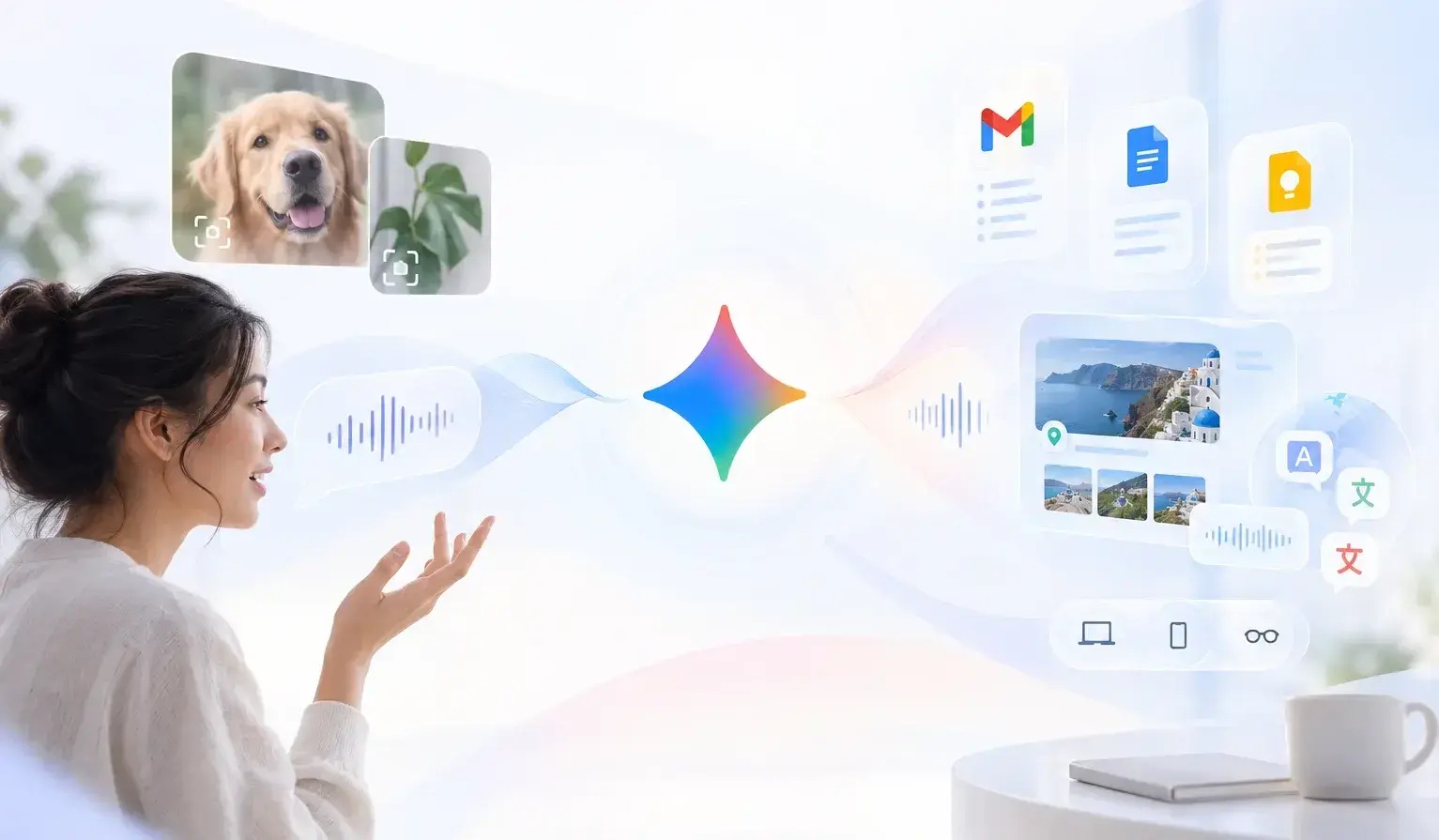
Gemini 3.8 Live is the everyday option, built for scale and cost efficiency. It pairs fluid dialogue with visual grounding, processing visual input in near real time. In practice, that means you can point a camera at something and talk about it as you look at it.
Gemini 3.8 Live Extended Thinking is the version built for genuine multi-step reasoning. It powers the higher-complexity experiences Google recently launched: Gmail Live (conversational search), Docs Live (draft generation and editing), and Keep Live (note creation).
What "Reasoning While Speaking" Actually Means
The headline capability of Extended Thinking is parallel reasoning — the model reasons and speaks at the same time.
Here's how it plays out. You make a request, and the model acknowledges it with an early verbal cue like "Let me check that…" — the same thing a person would do. While multi-step work runs in the background, it narrates its progress live. The conversation never stops to wait.
The base model works on the same principle: tools and API calls execute in the background while the chat continues. Users get their request acknowledged and keep talking while tasks finish.
The Benchmarks
Google published results from independent evaluations, and Extended Thinking lands at the top of most of them:
| Benchmark | Result |
|---|---|
| Artificial Analysis – Speech to Speech Quality Index | 82.6 (#1 overall) |
| Big Bench Audio (reasoning) | 97.7% |
| τ-Voice (agentic task completion) | 68.6% |
| Sierra's τ-Voice-banking | 35.1% |
The base Gemini 3.8 Live took second place in the Speech Agent Arena, a user-preference ranking — while holding onto its cost advantage.
The subtext is worth noting. Google isn't only competing on raw intelligence anymore; it's competing on being fast, cheap, and smart in the same model.
97 Languages, Switched Mid-Sentence
Both models support 97 languages, and more usefully, they detect and transition between them mid-conversation. You can start in one language, drop in a term from another, and the model doesn't stumble at the seam.
For anyone building customer-facing voice agents in multilingual markets, that's not a demo feature. It's the difference between one deployment and five.
Where You Can Use It
Distribution is unusually broad for a launch-day release:
- Developers: both models are available through the Gemini API and Google AI Studio.
- Enterprise: accessible in Gemini Enterprise under private preview.
- Search Live: the base Gemini 3.8 Live powers the Search Live experience in AI Mode, offering step-by-step, real-time troubleshooting help.
- Gemini Live: Extended Thinking is rolling out to the Gemini app.
- Workspace: Extended Thinking reaches Docs for Google AI Pro and Ultra subscribers, and Gmail and Keep for all Google AI subscribers.
Every generated audio output carries a SynthID watermark so AI-generated content stays detectable.
Pricing
For the standard model, audio input runs $0.005 per minute and audio output $0.018 per minute. On Extended Thinking, reasoning tokens plus additional inputs like video and documents are billed separately.
Per-minute pricing matters more than it sounds. If you know your average call length, you can forecast monthly cost directly — no token estimation guesswork, which has been a real friction point for teams pricing out voice deployments.
What It Means If You're Building
The bigger story here might be the release cadence. Gemini 3.8 Live landed just two weeks after Gemini 3.8 Flash and 3.8 Flash Cyber. Since midsummer, Google has shipped a major Gemini release roughly every three weeks.
For developers, the practical takeaway is that latency has largely moved from an application-layer problem to a model-layer one. The filler audio, the "thinking" animations, the artificial pauses engineered to cover dead air — a lot of that scaffolding becomes unnecessary.
Visual grounding opens a second category: technical support where the user points a camera at a broken device, field operations, hands-free training, and accessibility tools.
The Takeaway
Gemini 3.8 Live isn't a dramatic new-capability announcement. It's a sign that voice AI has moved from demo to production. Lower latency, predictable pricing, uninterrupted conversation — these are productization problems, not research problems, and solving them is what makes a technology deployable.
If you're planning a voice assistant or a support agent, both models are live on the Gemini API and AI Studio. Testing them against your own call patterns is the fastest way to find out which one fits.